For the hands that built, the hearts that pray, and the neighbors who still stand beside one another. ❤️🙏 From mountain roads and prairie fields to church bells and factory towns—may we choose courage over fear, compassion over division, and never give up on each other. 🦅✨
One nation. Many voices. One powerful reminder: This land still belongs to us. 🇺🇸❤️
Not left. Not right. The side that keeps the promise. ❤️🤍💙 The side that shows up when the waters rise, reaches out when a neighbor falls, and believes freedom belongs to all of us. 🕊️
We may not always agree—but we can still stand together. 🤝
Think’st thou the seal once pressed upon thy soul Constrains the Eternal Hand from just decree? That Mercy, tasted, mortgages the Throne And binds Omnipotence to lenity? O vain arithmetic of carnal hope, That reckon’st grace as coin once paid in full, And wouldst make Heaven debtor to thy sleep.
Attend: for Truth is not a silken nurse To rock the sluggard in presuming peace. The Word is flint; it strikes, and sparks of fear Leap living from the granite of the heart.
“To Ephesus,” saith He whose eyes are flame, “Thou hast forsaken love’s first ardency. Remember whence thou art declined; repent— Else will I move thy lamp from out its place.”
Not unto pagans sounded this rebuke, But unto those once bright with covenant light. O dreadful intimacy of grace— To stand within, yet tremble at removal.
What branch, once quickened by the parent Vine, May boast continuance while severed clean? He said not, Near Me—but, “In Me,” cut off; A paradox of privilege undone: To have been fed by sap of living Christ And yet lie sere beneath judicial sun.
For none is lopped from where no graft was set, Nor cast to flame who never bore the green. The fire consumes inheritance betrayed, Not barren heath untouched by husbandry.
And thou—be not high-minded, but in fear. If ancient boughs, first-nurtured, spared were not, What wild-olive, by mercy only set, Shall mock the root and think himself secure? Behold twin attributes in awful poise: Goodness that grafts—severity that prunes. Continue—or the axe remembers thee.
Consider those illumined once with dawn, Who tasted gift and Spirit’s rushing wind, And in that light discerned the Crucified— Yet chose eclipse, and crucified again The Lord of glory to their second shame. O terrible irreversibility Of light rejected with consenting will.
For falling argues altitude before; One cannot plummet from a depthless void. Apostasy is not of ignorance, But altitude abused into abyss.
“He that endureth shall be saved.” Not he Who blossomed briefly in the morning dew, But he whose root strikes downward through the drought, And holds though summer scorch and winter rend.
Salvation is no monument in time, Cold marble dated at conversion’s hour; It is a pulse, a respiration lived— A flame that feeds on watchfulness and prayer.
Grace is no cloak to dignify revolt, No charter signed for dalliance with sin. It is a sword that severs flesh from will, A fire that will not share the heart’s divided throne.
What covenant retains adulterous trust? What soldier crowned who deserts mid-war? What scholar claims the laurel of the wise Who shuts his book and mocks the Master’s voice? Continuation is the grammar of belief; Perseverance, its syntax and its seal.
Examine, therefore—art thou yet in Him? Abiding is the evidence of life. Lamps, though once kindled, perish without oil; Branches, though once in sap, grow dry through pride.
Return—while yet the Gardener walks the rows. Repent—while still the candlestick may stand. For He is constant in His offered grace, Yet constant also in His holy fire.
Let none baptize presumption into creed Nor preach immunity to trembling souls. The path is narrow not at entrance only, But narrow still where feet grow faint with years.
God is most faithful—this our anchor stands; His promise sure, His mercy vast and strong. Yet faithfulness He seeks in those He saves: A faith obedient, vigilant, aflame.
Therefore walk softly in triumphant awe— Not doubting Him, but doubting thine own strength. For grace is power, not permission; life, Not license for the old man’s lingering throne.
Abide. Endure. Repent when thou dost fall. The crown is not for those who once began, But those who, having begun, refuse to cease— And stand at last because they stood in Him.
Before the scarlet rose unclosed its bloom, Before the vine first learned its reaching art, Before the hidden earth released its scent Warm to the hush of any lover’s breath— My heart was set on thee.
“I have loved thee with an everlasting love; Therefore with lovingkindness have I drawn thee.” So was it spoken ere thy pulse began, And thou wast known before thou knew’st My Name.
Thou dwelt as wintered orchard, branch unbloomed, A bud drawn tight against imagined frost. Thou saw’st the velvet rose in offered palm, The sugared sweetness melting slow and dark, The folded note bound fast with crimson thread, The candle trembling in consenting dusk— Yet still thy spirit lingered, half-afraid.
For thou didst fear the breaking of the seal. What if the letter summoned all thy heart? What if the sweetness vanished into ache? What if the bloom once opened bruised by wind?
Beloved, I knew.
I waited, patient as unopened wine Deep in the cask of centuries concealed; As dark and rich as chocolate unbroke, Holding within its velvet weight a flame— Not fleeting sugar of a passing feast, But bread and wine that quicken unto life.
For God so loved the world, that He gave His only begotten Son, That whosoever believeth in Him Should not perish, but have everlasting life.
Love did not linger distant from thy need— It gave; it came; it bore; it overcame.
First came Storge, soft as woven wool, The hearth-light haloing thy cautious frame. “My child,” it whispered through thy midnight doubt; And sap long silent stirred beneath the bark.
Then Phileo, clear as morning air: “I call thee friend,” it sounded in thy bones; And laughter, long entombed, began to rise.
Then covenant flame, disciplined and deep: “Set Me as seal upon thine heart; For love is strong as death.” Its warmth was holy—neither rash nor wild— A crimson ribbon binding vow to vow.
Yet over all, and through all, Agape moved— The ocean under every lesser tide. While thou wert yet uncertain, I was sure. While thou wert yet concealed, I saw thee whole.
“Greater love hath no man than this, That a man lay down his life for his friends.”
So was My heart poured forth like richest wine; The crimson fell more deep than any rose. Upon the tree My love stood written plain; The thorn and nail became love’s lexicon. “It is finished,” breathed My wounded side.
The stone was moved; the morning split the dark; “He is not here; for He is risen.” The garden breathed with resurrection warmth; The air itself grew golden with new life.
And I called thee.
As bridegroom calling through the orchard rows, As shepherd calling through the lifting mist, As lover whispering thy hidden name Where pulse and promise meet.
O thou who feared the breaking of the seal, Behold the letter written in My blood. O thou who trembled at the melting sweet, Taste and see that I am good.
Then came the yielding.
From bud to bloom; From bloom to fragrance loosed upon the wind; From guarded sweetness unto shared delight; From solitary hush to answered vow.
“Perfect love casteth out fear.”
Beloved, thou art Mine.
Not as a token fading with the feast, Nor as a rose pressed pale in passing years— But as the vine abides within its root, As wine abides within the living grape, As pulse abides within the breathing breast.
Holy, holy, holy, Love most high, Whose banner over me is love; Holy, holy, holy, risen King, Whose heart was pierced that mine might beat.
For before the rose, I loved thee. Before the wine, I chose thee. Before the dawn, I knew thee.
The Missionary Child from Zion — The Rose-Gathering Canticle
A Canticle in Eight Acts with Interludes
IN PROLOGUE
Before the sun had learnt his golden trade, Before the moon had hung her silver lamp, Ere clocks had teeth, ere seasons had a name, There was but Breath, and Word, and Will—אֱלֹהִים (Elohim)—“God.” And in that hush, where nothing yet was “then,” A child was set—no babe of flesh alone, But purpose clothed in wonder’s mortal gown: A maiden small, yet vast with borrowed hours, Whose feet were shod with ages, not with dust. From Zion’s height (though Zion yet slept unborn) Her calling rang: הִנֵּנִי (Hineni)—“Here am I.”
Her name the scrolls write not; for she is sign, A lamp to those who stumble in the dark. She is The Missionary Child from Zion— Not sent to change the tale, but tell it true; To walk the corridors of holy time And ask of every turning, every tear, What God did speak, and what His people heard.
And still one question, like a pulse of fire, Beat in her breast through all the whirling years: “Where is the Anointed—where is Christ? When shall the Promise stand with mortal feet, And how shall man be made a new-made man?”
So let the curtain rise on beginnings.
ACT I — GENESIS: THE GARDEN, THE WOUND, THE ROAD
She saw the light break out as if a harp Were struck by God, and darkness fled in shame. The waters shivered, hearing “Let there be,” And air was born with scent of newborn rain. She tasted morning—clean as uncut fruit— And heard the deep like drums beneath the world.
Then Eden: green so sharp it seemed to sing; A river’s laugh; the cool of evening’s step When God did walk. She watched the man, the woman, Two candles set within a glass of peace. The serpent’s whisper slid like oil on stone; The bite rang loud though teeth made little sound— And suddenly the garden knew of thorns. She felt the first shame burn upon the skin, The first hard gulp of sorrow in the throat, And saw the flaming sword bar gentle gates.
She followed exile’s footprints into dusk, Watched brother lift his hand against his blood— And heard the ground cry out. She pressed her ear To soil that drank a life it should not take. She stood beside the ark when skies unbuckled, When rain fell thick as judgment’s iron beads, And smelled the pitch, the wet of frightened beasts, The musk of survival in a floating world. She saw the rainbow—God’s bright bow unstrung— A painted oath across the washed-blue air.
Then Abram: star-eyed under desert frost. She counted heavens with him, breath by breath. A covenant cut; a promise stitched to time; A child of laughter (Isaac) born of dust and grace. She climbed the mount where knife and mercy met— And heard the ram’s hooves scrape the bristled thorn. “God will provide,” the air itself confessed.
She watched the wrestle in the midnight river, When Jacob held and would not let God go— And limped away with blessing like a bruise. She walked with Joseph through a pit’s cold mouth, Through prison’s stale, through Egypt’s perfumed courts, To famine’s end, where forgiveness fed the world.
And all along, the child kept asking low: “O Lord—Adonai—Thy promise, where doth walk? Who is the Seed that crushes serpent’s head?”
Interlude of Roses — Genesis
Litany
CHILD: “My lord of clay, if I may beg but this—one single rose?” ADAM: “I have but sweat and thistle—yet take what Eden left me.” ROSE: A pale blush rose, dew-laden, with a faint green at the stem—like innocence remembering.
CHILD: “Mother of sorrows, grant me one rose—only one.” EVE: “If I had kept the garden, I would give thee gardens. Take.” ROSE: A white rose veined with soft gold, scented like crushed apple and twilight regret.
CHILD: “Sir, I ask no tale, no alms—only a rose.” CAIN: “Wilt thou take from me?” CHILD: “A rose may yet grow where blood hath fallen.” ROSE: A dark maroon rose, almost black, velvet-petaled, smelling faintly of iron and smoke.
CHILD: “Gentle one, one rose—may I?” ABEL: “Freely.” ROSE: A soft lamb-white rose, small and trembling, with a honey-sweet fragrance.
CHILD: “Righteous sailor of judgment’s sea—one rose?” NOAH: “After flood, all gifts are mercy. Take.” ROSE: A rainwashed blue-lavender rose, cool-scented like wet cedar and clean earth.
CHILD: “Father of promise—one rose, I pray.” ABRAHAM: “Child, the Lord provided the ram; He may provide thy rose.” ROSE: A deep desert-sand rose, tawny and warm, edges kissed with crimson like altar-fire.
CHILD: “Beloved son of laughter—one rose?” ISAAC: “If laughter lives, let it bloom.” ROSE: A bright yellow rose, sunbold, with citrus perfume—joy surviving fear.
CHILD: “Prince who wrestled—one rose?” JACOB: “Take it, little pilgrim; it is won by clinging.” ROSE: A striped rose—cream and scarlet twisted together—like struggle braided into grace.
CHILD: “Dreamer and governor—one rose?” JOSEPH: “For those who meant it ill—God meant it good. Take.” ROSE: A royal purple rose, plush as velvet, smelling of myrrh and sweet wine.
ACT II — EXODUS TO DEUTERONOMY: SLAVERY’S CRY, THE SEA’S SPLIT HEART, THE LAW’S BRIGHT EDGE
She heard in Egypt bricks that thudded dull— The sound of backs bent double under sun. She tasted ash in mouths that dared to pray. Then came a bush that burned yet would not die— A flame like holiness that harms no leaf. Moses removed his shoes; she felt the ground As if it breathed: Most near, most otherworld.
Plagues marched like drums through Pharaoh’s granite will; Frogs, gnats, and darkness thick as tarred despair. She smelt the lamb’s warm blood on doorposts painted— And heard the night-breath pass, the firstborn’s cry. Bread rose not; haste was bitter on the tongue; Yet freedom’s first taste cuts like sharp new wine.
The sea stood up like walls of startled glass; She ran between them where the salt wind roared, Where fish stared out like witnesses in blue. Behind: the chariot’s rage; ahead: the dawn— And then the waters fell like clapping hands, And tyranny sank, gurgling, into silence.
In wilderness she heard the manna fall— Soft as a hush, like dew with heaven’s scent. She saw the rock give drink, the staff strike stone, And thirst turn sweet upon a desert lip. At Sinai lightning wrote with violent quills; The mountain smoked; the people shook like reeds. And God spoke Law—not chains, but a clean road: “Hear, O Israel”—שְׁמַע יִשְׂרָאֵל (Sh’ma Yisra’el)—“Hear, O Israel.”
Yet in the camp, gold glittered like betrayal; A calf, a dance, a faith grown thin and loud. She watched the tablets shatter—thunder made to stone— And felt the ache of love refused.
Through Leviticus, the blood of sacrifice Steamed iron-sweet in air of tabernacle, Not gore for gore, but shadow of a cure: A holy lesson—sin is deathward deep, Yet God makes way for sinners to draw near.
In Numbers, she walked circles of complaint, Heard serpents hiss; saw bronze made healing sign; Watched rebels swallowed by the yawning earth. In Deuteronomy, Moses’ farewell shook, A father’s voice on brink of promised land— Then Nebo’s height; the last long look; the grave Known only unto God.
And still her question grew a stronger wing: “These lambs, these laws—what do they point unto? Who is the Passover, the living Door?”
Interlude of Roses — Exodus to Deuteronomy
Litany
CHILD: “Great king—grant me one rose.” PHARAOH: “A slave-girl’s whim?” CHILD: “Nay—only a rose.” ROSE: A hard, blood-red rose, glossy as lacquer, thorns sharp as pride, scent faintly bitter.
CHILD: “Lawgiver—one rose, if I may.” MOSES: “Child, thou art tender; this desert bites. Yet take.” ROSE: A scarlet-and-white rose, like fire rimmed with cloud, smelling of smoke and clean rain.
CHILD: “Priest of intercession—one rose?” AARON: “For atonement’s sake, take it.” ROSE: A snow-white rose with a faint crimson heart, like purity marked by mercy.
CHILD: “Captain of crossing—one rose?” JOSHUA: “As the Lord bade, so shall I give.” ROSE: A strong orange rose, sunrise-bright, smelling of crushed citrus and brave beginnings.
ACT III — JOSHUA TO ESTHER: LAND, KINGS, EXILE’S TEAR, AND HIDDEN HANDS
She watched the Jordan halt like startled time; Its waters rose as if obeying breath. Jericho’s walls fell down to trumpet-blast— Not siege by steel, but praise that split the stone.
In Judges, she saw cycles like a wheel: Sin, sorrow, cry, deliverance, then sin again— A nation stumbling, yet not cast away. She heard the strength of Samson snap like rope, And Delilah’s soft betrayal in the dark.
Then Ruth: a gleaner in the barley’s gold; She smelled the harvest, heard the gentle vow: “Where thou goest, I will go.” A foreign widow folded into grace— A thread that led to kings.
In Samuel’s days, she heard the boy cry “Here” Within the night where lamps were growing low. Saul rose tall—then fell by disobedience. David sang psalms that tasted salt and honey, Fought giant fear with smooth and whistling stone, Then sinned, then wept, then found mercy’s stern embrace. Solomon’s wisdom flashed like polished bronze, Yet his heart wandered after many loves. The kingdom split like cloth torn down the seam.
Prophets thundered; idols clinked; the poor were crushed. Elijah called down fire; she felt the heat Scorch air like judgment. Yet in whisper small— Not storm nor quake—God spoke a quieter flame.
Then exile: Babylon’s long iron song. She sat by rivers where the harps hung mute, And tasted tears that salted foreign bread. In Daniel’s den she heard the lion’s breath— Hot, beastly—yet restrained by unseen hand. She smelled the furnace’ blaze where three men stood And saw a fourth like “son of gods” beside them.
Esther—hidden courage in a royal hall— Risked life with trembling poise: “If I perish…” And deliverance came, though God’s Name stayed unspoken— A mystery of providence behind the veil.
And still the child, now older in her eyes, Would ask the night, would ask the shining day: “If God is faithful, why this endless wound? Where is the King whose reign makes hearts made whole?”
Interlude of Roses — Joshua to Esther
Litany
CHILD: “Strong one—one rose?” SAMSON: “My hands break gates, yet could not guard my heart. Take.” ROSE: A huge crimson rose, heavy-headed, smelling of musk and bruised pomegranate.
CHILD: “Lady—one rose, I pray thee.” DELILAH: “Why should I?” CHILD: “For nothing thou needst know.” ROSE: A pale peach rose, deceptively sweet, fragrance like honey over a hidden blade.
CHILD: “Kind gleaner—one rose?” RUTH: “If thou art hungry, child, take grain—and take the rose besides.” ROSE: A soft coral rose, warm as hearthlight, smelling of bread and field-wind.
CHILD: “Prophet-child grown old—one rose?” SAMUEL: “Speak, little one.” CHILD: “Only: may I have a rose?” SAMUEL: “Then take it, and keep thy listening heart.” ROSE: A clear white rose with silver sheen, scent like olive blossom and clean linen.
CHILD: “O king—one rose?” SAUL: “Wouldst thou take from me, who lost the favor I once held?” CHILD: “A rose may be given even by a trembling hand.” ROSE: A thorn-rich rose, red fading to rust, scent sharp like cedar-sap and regret.
CHILD: “Sweet psalmist—one rose?” DAVID: “Take it—God desireth truth in inward parts.” ROSE: A deep pink damask rose, perfume rich as song, with a salt note like weeping turned to worship.
CHILD: “Wise king—one rose?” SOLOMON: “All is gift, child; wisdom too is borrowed. Take.” ROSE: A golden-ivory rose, petals thick as parchment, scented with frankincense and cedar.
CHILD: “Prophet of flame—one rose?” ELIJAH: “In the still small voice, child—there bloometh gentler things.” ROSE: A bright scarlet rose edged with white, like fire kissed by whisper, scent like smoke and mint.
CHILD: “Faithful exile—one rose?” DANIEL: “God shut the lions’ mouths; may He keep thy heart.” ROSE: A midnight-blue rose (so dark it seems black) with a cool spice scent like star-anise and stone.
CHILD: “O steadfast ones—one rose each?” THE THREE MEN: “We will not bow—yet we may give.” ROSES: Three roses, each distinct: one pure white; one vivid orange; one red like molten ember—each smelling of clean air after fire.
CHILD: “Queen of courage—one rose?” ESTHER: “If it be for life, I give it.” CHILD: “It is for…a love thou needst not name.” ROSE: A regal red-and-gold rose, petals like satin, scent like rosewater and trembling bravery.
ACT IV — JOB TO SONGS: WISDOM’S DEPTH, LOVE’S FIRE, AND PRAYERS LIKE LAMPS
In Job she heard the honest howl of man— Cinder on the skin, questions like jagged glass: “Why?”—that word that cuts the throat of peace. And God replied—not petty explanation, But whirlwind grandeur: seas, constellations, beasts— The world too wide for small, proud certainty. Job bowed, and found that mystery can be mercy, And dust may yet be held by holy hands.
In Psalms, the child drank music like cool water: “Lord is my shepherd”—green pastures in her mind; “Out of the depths”—a sob turned into prayer; “Hallelujah”—praise like bells in storm. In Proverbs, wisdom called in city streets; In Ecclesiastes, vanity wore a crown; In Songs, love burned like coals that none can quench— A hint of greater Love that would not fail.
Her question changed its clothing, yet stayed one: “How shall the Holy dwell with broken ones? How shall the heart be washed, not merely warned?”
Interlude of Roses — Wisdom Books
Litany
CHILD: “Sufferer—one rose?” JOB: “Though He slay me—yet will I trust. Take.” ROSE: A smoke-gray rose touched with lavender, scent like rain on dust—lament softened into faith.
CHILD: “O songs of Zion—grant me one rose.” THE SONGS: “Take praise, take ache, take hallelujah.” ROSE: A many-petaled pink rose, layered like harmonies, fragrance like honeyed breath and salt tears.
CHILD: “Lady Wisdom—one rose?” WISDOM: “Choose me, child, above rubies.” ROSE: A clear apricot rose with copper edges, scent like ripe fig and warm parchment.
CHILD: “O love—one rose?” LOVE: “Set me as a seal upon thine heart.” ROSE: A lush crimson rose with a velvet black center, scent intoxicating—wine, spice, and longing.
ACT V — ISAIAH TO MALACHI: PROMISE SHARPENS, SILENCE GATHERS
Isaiah opened like a temple door— She saw the throne, the seraphim’s bright cry: “קָדוֹשׁ, קָדוֹשׁ, קָדוֹשׁ”—Kadosh, Kadosh, Kadosh— And felt her own uncleanliness like smoke. Then promise poured: a virgin, a child, a name— Wonderful Counselor, Mighty God, Prince of Peace; A servant wounded, pierced, rejected, crushed— Yet bearing many, healing by His stripes. She trembled, tasting prophecy like iron.
Jeremiah wept—his tears were stones of truth. He spoke of a New Covenant written not on rock But on the heart. Ezekiel saw wheels And heard of bones made flesh by Spirit’s breath— A valley singing life where death had camped. Hosea lived the ache of faithful love Chasing a wandering bride.
Jonah ran—she smiled at that wild flight— Yet mercy chased him to the deep’s dark throat, And Nineveh repented. Micah spoke it plain: Do justice; love mercy; walk humbly with thy God.
Then Malachi—last prophet’s closing chord— A promise: one will come to turn the hearts; A messenger will clear the coming way. And after that—a silence long and thick, Four hundred years where scripture’s ink lay still. The child walked through that hush as through cold fog, Hearing in absence the loud ache of longing.
Now her one question blazed as bright as dawn: “Is He at hand? Will God Himself draw near? Will Word take flesh—and if He comes…where?”
Interlude of Roses — The Prophets
Litany
CHILD: “Seer of holiness—one rose?” ISAIAH: “Here is thy sign: the Lord shall comfort. Take.” ROSE: A pure white rose edged in crimson, scent like smoke and lilies—purity and sacrifice in one.
CHILD: “Weeping prophet—one rose?” JEREMIAH: “My eyes run down with rivers. Yet take.” ROSE: A soft violet rose, drooping slightly, fragrance like wet stone and mourning incense.
CHILD: “Watchman—one rose?” EZEKIEL: “The heart of stone shall be made flesh. Take.” ROSE: A strange green rose (pale jade), crisp-scented like fresh herbs—new heart, new breath.
CHILD: “O steadfast visions—one rose.” VISION: “The Most High ruleth.” ROSE: A starry-speckled white rose, as if dusted with night, scent like cool myrrh.
CHILD: “Husband of sorrow—one rose?” HOSEA: “Love that returns is God’s own parable. Take.” ROSE: A soft red rose with a torn-looking edge, yet fragrant—rosewater and salt—love that bleeds and stays.
CHILD: “Runaway prophet—one rose?” JONAH: “Mercy swallowed me and spat me back. Take.” ROSE: A sea-foam pale rose, almost pearl, scent like brine and clean wind.
CHILD: “Speaker of justice—one rose?” MICAH: “Walk humbly.” ROSE: A simple wild rose, pink and open-faced, scent like sunwarmed grass and honesty.
CHILD: “Last herald—one rose?” MALACHI: “He cometh—prepare.” ROSE: A deep ember-orange rose, glowing at the edges, scent like cinnamon and coming dawn.
ACT VI — THE GOSPELS: THE FACE SHE SEEKS, AT LAST IN DUST AND BREATH
Then—Bethlehem. Not marble halls, but stable’s sour hay; Warm animal breath; the sweet, sharp milk of life; A mother’s groan; the cry that split the night. She heard the angels tear the sky with song, And shepherds come with mud upon their heels. A star stood still like heaven holding breath. Magi bowed, and frankincense bit the air.
A tyrant raged; children were slaughtered— Her stomach clenched; her tears ran hot and fast. Yet flight to Egypt saved the promised Child, And prophecy folded in on prophecy.
Jordan’s waters kissed the carpenter’s bare feet. The heavens opened; Spirit dove like peace; A voice: “My Son beloved.” And in the wilderness the tempter came— Not with horns, but with clever words and hunger— Yet Christ stood firm; the bread of God prevailed.
She followed Him through villages of ache: Blind eyes opened like windows at sunrise; Lepers, once rot and loneliness, were touched— And touch was medicine. She heard demoniacs Scream as darkness fled. She watched the widow’s son Sit up and breathe, as death forgot its name. She heard Him say, “Thy sins be forgiven”— And felt the scandal and the mercy clash.
He ate with sinners; Pharisees grew sharp; He told of seeds and pearls, of sons who ran, Of fathers who ran faster. He stilled the storm; the sea obeyed like dog That knows its master’s step. He fed the crowds— Five loaves, two fish—and fullness overflowed. On holy mount, His face became a sun; His garments shone; Moses and Elijah spoke— And awe fell heavy as a mantle on the air.
And still the Missionary Child would ask Him— Not doubting now, but hungering to know: “Why come this way—through sorrow, dust, and blood? What is Thy mission, Lord—what art Thou here to do?”
Then came the week where palm leaves kissed the road, Hosannas loud as waterfalls in spring— Yet underneath, betrayal warmed its knives. A supper room: bread broke like body soon; Wine dark as coming pain; a basin, towel— The King kneeling to wash unworthy feet. “Love one another.” Outside: Gethsemane—olive trees like witnesses, Night thick with prayer pressed out like oil. He sweat like blood; the child could taste the fear Metallic in the air.
Judas’ kiss. The torches. The false witness. The rooster’s cry that broke bold Peter’s heart. The lash. The crown of thorns. The Via Dolorosa— Stones underfoot slick with spit and shame. Nails rang like hammers in the skull of earth. The sky went dark at noon. She heard Him cry (Aramaic torn from depth): אֵלִי אֵלִי לָמָה שְׁבַקְתַּנִי (Eli, Eli, lama sh’vaqtani)—“My God, My God, why hast Thou forsaken Me?” She smelled the vinegar; she heard the jeers; She watched the curtain of the temple tear— As if God ripped the barrier Himself. And then: “It is finished.” A spear. Water and blood. A borrowed tomb, cold as unanswered grief.
Here is the climax, the turning of all worlds: The child fell down, her question cracking open— Not “Where is Christ?” but “What is love?” And love answered with a cross.
But dawn returned with shock of rolling stone— A quake; guards like dead men; graveclothes left behind Like shed-off winter. “Mary,” He spoke—one word that made her weep. He ate; He walked; He showed His wounded hands— Not hiding scars, but crowning them with peace. To Thomas: “Touch and see.” To all: “Go—make disciples.”
Then, lifting from their sight, He rose— And angels said He would return again.
The Missionary Child, trembling with bright tears, At last knew what her mission always was: To bear true witness—book by book, breath by breath— That every road of Scripture leads to Him; That sacrifice and kingdom, exile and return, Are threads that bind the world unto the Christ.
Interlude of Roses — The Gospels
Litany
CHILD: “Blessed woman—may I ask one rose?” MARY (mother): “Little one, what lack’st thou?” CHILD: “Only a rose.” (Her voice breaks like thin glass.) ROSE: A pure white rose with a blush-pink heart, fragrance like warm bread and lullaby tears.
CHILD: “Good sir—one rose?” JOSEPH (guardian): “I am but keeper; yet take.” ROSE: A modest cream rose, sturdy stem, scent like cedar shavings and honest labor.
CHILD: “Fathers of the field—one rose?” SHEPHERDS: “We have but praise—yet take.” ROSE: A wild dog-rose, soft pink, open and starry, scent like grass and night air.
CHILD: “Wise travelers—one rose?” MAGI: “Thou ask’st a small thing—take it.” ROSE: A rich red rose dusted with gold pollen, scent like frankincense and distant roads.
CHILD: “King—may I ask one rose?” HEROD: “Why?” CHILD: “For nothing I will tell.” ROSE: A harsh crimson rose with jagged thorns, scent thin and sharp—like power rotting at the root.
CHILD: “Voice in wilderness—one rose?” JOHN THE BAPTIST: “He must increase.” ROSE: A simple white rose with a blue tint at the edge, scent like river-water and repentance.
CHILD: “Sir—one rose?” JUDAS: “Dost thou mock me?” CHILD: “Nay. I am only…hungry to gather beauty.” ROSE: A sickly pale rose streaked with gray, scent faint—like perfume spilled on cold stone.
CHILD: “Fisher—one rose?” PETER: “I denied Him.” CHILD: “Then give, and weep.” ROSE: A deep sea-pink rose, salted at the petals, scent like brine and forgiveness.
CHILD: “Doubter made sure—one rose?” THOMAS: “My Lord and my God.” ROSE: A white rose with a red-splashed tip, scent like clean linen and startled faith.
CHILD: “Woman of the garden—one rose?” MARY MAGDALENE: “I have seen the Lord.” ROSE: A bright dawn-rose—pink turning to gold—scent like morning air and astonished joy.
CHILD: “Rabbi…Adonai…if I may ask…” (Her throat floods; words drown.) “…one rose?” CHRIST: (Soft as bread in His own hands.) “Little one.” CHILD: “Only a rose.” (She cannot tell Him. She cannot.) ROSE: A rose beyond naming—white and red together, as if snow and blood agreed; fragrance like myrrh, like honey, like home. It hurts to breathe it.
ACT VII — ACTS TO JUDE: FIRE ON TONGUES, CHAINS AS HYMNS, AND LETTERS LIKE LAMPS
At Pentecost she heard a rushing wind Fill up the house; she saw the tongues of fire Rest on the heads of ordinary men— And common speech became a holy flood. Three thousand hearts were pierced; baptism waters Sparkled like joy in sun.
She walked with apostles through prisons’ iron breath: An angel opened doors; chains fell like leaves. She watched Stephen die with heaven in his eyes, Praying for those who threw the stones. She followed Saul—now Paul—struck blind by light, Made new by grace, a former wolf turned shepherd.
She sailed with him through storms; she heard the hymns Sung in the midnight cells; she saw shipwrecks, Serpents, riots, councils, and bold defense— And always Christ proclaimed.
Then letters—Romans’ depth of grace; Corinthians’ love that bears and hopes; Galatians’ freedom; Ephesians’ armor bright; Philippians’ joy in chains; Colossians’ Christ supreme; Thessalonians’ hope of His return; Timothy, Titus—steadfast order in the flock; Hebrews’ great High Priest; James’ living faith; Peter’s suffering, John’s abiding love; Jude’s warning to contend.
The child learned this: the Church is not a throne, But pilgrim feet upon a bloody road; And still the question—now refined to flame— Became the cry of every watching heart: “How shall we endure till Thou return, O Lord?”
Interlude of Roses — Acts and the Letters
Litany
CHILD: “Martyr bright—one rose?” STEPHEN: “Lord, lay not this sin to their charge.” ROSE: A luminous white rose, almost glowing, scent like clean air and heaven-near peace.
CHILD: “Apostle—one rose?” PAUL: “Grace be with thee.” ROSE: A thorny red rose with a strong straight stem, scent like ink and ship-salt—mission sharpened into mercy.
CHILD: “Son in the faith—one rose?” TIMOTHY: “Pray for boldness.” ROSE: A shy pale pink rosebud, barely opened, scent like spring—courage learning to bloom.
CHILD: “Builder of order—one rose?” TITUS: “Let all things be done with soundness.” ROSE: A firm coral rose, tidy petals, scent like citrus and clean linen.
CHILD: “Teacher—one rose?” JAMES: “Be ye doers.” ROSE: A practical wild rose, rose-red with strong hips, scent like earth and honest sweat.
CHILD: “O suffering counsel—one rose.” LETTER: “Hope to the end.” ROSE: A resilient rose, deep red with frost-white edges, scent like winter and endurance.
CHILD: “Beloved elder—one rose?” JOHN: “Little children, love one another.” ROSE: A soft white rose with a pink halo, fragrance gentle—like comfort after fear.
CHILD: “Contender—one rose?” JUDE: “Keep yourselves in the love of God.” ROSE: A sharp-scented red rose with pointed petals, smelling of spice and vigilance.
ACT VIII — REVELATION: THE VEIL LIFTS, THE LAMB REIGNS, THE WORLD MADE NEW
Patmos: salt wind; rock; the smell of seaweed; An old man exiled with a burning pen. The child stood near as visions broke like waves: Lampstands; seals; horsemen; trumpets; bowls of wrath; A dragon’s rage; a beast’s loud blasphemies; A scarlet harlot; Babylon’s collapse; The Rider True; the Word like sharpened sword; The dead raised up; the books; the final court.
Then—like rain after a long drought— A new heaven, and a new earth, and holy city, New Jerusalem, descending bright as bride. No more death; no mourning; no crying; no pain. A river clear; the tree of life in fruit; And God Himself with men.
And here the last great note: the Spirit and the Bride Say, “Come.” And Christ: “Surely I come quickly.” The Church replies in Aramaic prayer: מָרַנָא תָּא (Maranatha)—“Our Lord, come.”
Interlude of Roses — Revelation
Litany
CHILD: “Seer of the end—one rose?” JOHN: “Write what thou hast seen.” ROSE: A stark white rose with icy blue undertone, scent like sea-salt and lightning.
EPILOGUE — “UP UNTIL THIS TIME”: THE CHILD TURNS TO US
Now stands the Missionary Child from Zion At the edge of our own loud, electric days— Where screens glow blue like restless, sleepless seas, Where many know of Christ yet do not know Him, Where hearts are hungry though the tables groan.
She does not add to Scripture; she does not gild it— She simply tells it, with all senses awake: The hay of Bethlehem, the salt of Galilee, The cedar smell of Solomon’s proud halls, The ash of exile, the blood of covenant, The thunder of Sinai, the hush of empty tomb.
And if you ask: what one and only thing This time-traveling witness most would ask— It is this, distilled from every age and ache:
The Child’s One Burning Question
“How shall a human heart be made clean and whole— and how shall we live, faithful and unafraid, until the King returns?”
The Child’s Mission
To testify—book by book—that God’s works are true, that His promises are not tales but covenants, and that all roads of Scripture converge in Christ: Creator, Redeemer, Lamb, King, and Coming Lord.
When She Realizes
She senses it from the first promise in Eden— yet she knows it fully at the Cross and the Empty Tomb: that her wandering was always a guided path, and her purpose was always witness, not wandering.
CODA — The Foot of the Cross, and the Roses He Never Had
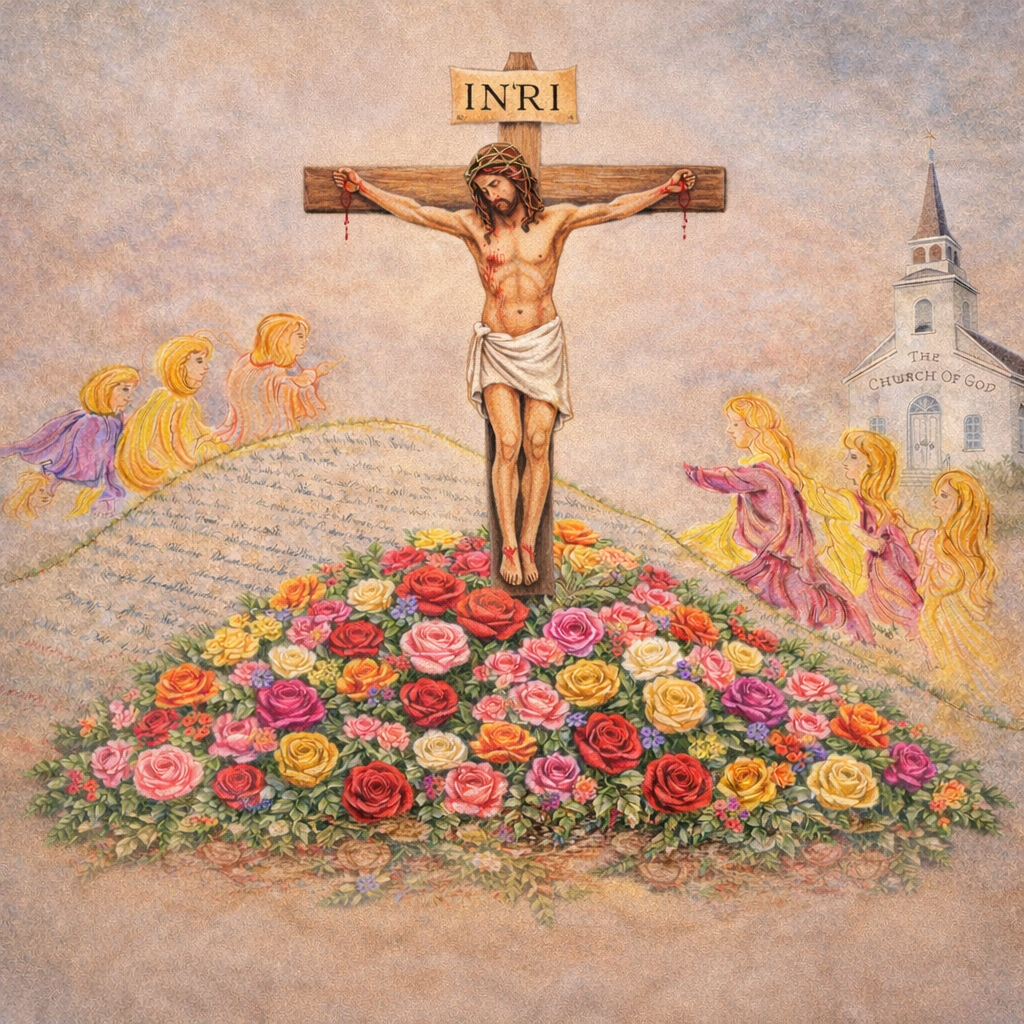
And now—O hush. She comes again to Golgotha, not in thunder, But on small feet that tremble with devotion. Her arms are full—so full—of gathered beauty: Roses of desert sand and river mist, Roses of exile and of homecoming, Roses of kings and widows, prophets, martyrs, Roses of sinners’ night and saints’ hard dawn— Each one a different tongue of color speaking, Each one a different wound made into perfume.
She has not told a soul. Not Adam, bowed beneath the first “alas,” Not Abraham, who measured stars like promises, Not Moses, whose hands held law and longing, Not David, wet with psalms, Nor Esther, brave in silence— Not even Peter, broken open into love— Not even Mary, mother of the Lamb— Not even Him.
Yet all the while she saw it—she saw it true: The Christ, who gives Himself for every nation— For every color under heaven’s lamp, For every language ever breathed as prayer— He stood with blood for garment, thorns for crown, And no rose in His hand. No soft thing. No sweet thing. No beauty offered— Save what His own torn love had made of shame.
And she—oh child—she cannot bear it. Her hunger is not for bread, but to give beauty To One who fed the world with His own heart.
So she kneels down. The ground is hard. The air is iron. Her throat is salt. Her tears fall fast—like that first rain on Eden’s exile. She lays the roses down, not in a heap, But one by one, as if each were a name That God remembers.
She places first the Eden-blush rose— Then Noah’s rainwashed lavender— Then Abraham’s sand-warm flame-edged bloom— Then Moses’ fire-and-cloud rose— Then Ruth’s hearth-coral kindness— Then Isaiah’s white-with-crimson prophecy— Then Mary’s lullaby-white rose— Then Stephen’s luminous peace— Then Paul’s thorny mission-red— Then the nameless rose Christ gave her— White and red together, like mercy married to pain.
She does not speak her secret still— Only whispers, scarcely sound at all:
“הִנֵּנִי… Hineni.” Here am I. Small. Nothing. Glad.
And if the world could hear her heart, it would hear this: Not pride, not show, not poetry for applause— But a child, deliberate in mission, sweet as dawn, Trying to give a suffering Savior One small garden’s worth of tenderness.
Then, in the hush where sorrow turns to gold, It seems the wind grows softer round the cross— As if the universe inhales the rose-scented offering And lets it out as peace.
And she, her cheeks all wet, her hands all empty, Looks up into the face she sought through time— And though she never tells what the roses were for, Her eyes do.
For in her gaze is every era’s ache made gentle, And every color’s beauty laid in love, And every language gathered without fear— And one unspoken truth, more lovely than a crown:
That the Lamb who wore thorns for all the earth Shall yet be honored— Even by a child— With roses.
עֵץ הַזַּיִת עוֹמֵד מוּל הַזְּמַן, The olive tree stands before time, עוֹד לִפְנֵי שֶׁשָּׁעוֹן נִלְמַד לִסְפּוֹר, before clocks learned how to count, וַעֲנָפָיו רוֹשְׁמִים שָׁנִים בַּשָּׁמַיִם, its branches inscribing years in the air, כְּתִיבָה שֶׁאֵינָהּ נִמְחֶקֶת. a handwriting that does not fade.
שָׁרָשָׁיו עֲמֻקִּים מִן הַזִּכָּרוֹן, Its roots are deeper than memory, נְעוּצִים בִּבְרִית שֶׁקָּדְמָה לַקּוֹל, anchored in a covenant older than speech, וּדְמָעוֹת אָדָם נָפְלוּ סְבִיבָיו, and human tears fell around it, כְּמַיִם שֶׁאֵינָם מְמִיסִים הַבְטָחָה. waters that never dissolved the promise.
נִכְתַּב הַדָּבָר בְּעוֹלָם שֶׁעָדַיִן הֶאֱמִין, The word was written when the world still believed, וְנֶחְתַּם בְּחוֹתָם שֶׁל אֱמֶת, sealed with the signet of truth, גְּלִיל נִגְלַל וְנִשְׁמַר, a scroll rolled shut and guarded, וּדְבָרִים עַתִּיקִים הִמְשִׁיכוּ לִנְשֹׁם. while ancient words continued to breathe.
מַמְלָכוֹת קָמוּ כְּעָנָן בַּבֹּקֶר, Kingdoms rose like mist at dawn, וְנָפְלוּ כְּצֵל בְּעֶרֶב, and fell like shadows at evening, בָּבֶל נִדְמְמָה בְּקוֹל שֶׁל חֶרֶס נִשְׁבָּר, Babylon fell silent with the sound of broken clay, וְצוֹר נִגְרְדָה עַד הַסֶּלַע שֶׁתַּחְתֶּיהָ. and Tyre was scraped down to the rock beneath her.
כֶּסֶף נִשְׁקַל בְּכַף רוֹעֶדֶת, Silver was weighed in a trembling hand, וְהַמָּשִׁיחַ עָמַד בְּלִי מָגֵן, and the Messiah stood without defense, נּוֹלַד בְּבֵית־לֶחֶם בְּשָׁעָה שֶׁל שֶׁקֶט, born in Bethlehem in an hour of quiet, וְהָעוֹלָם חָלַף עָלָיו בְּמְהִירוּת. while the world hurried past Him.
יָדַיִם נִפְתְּחוּ לַכְּאֵב, Hands were opened to pain, רַגְלַיִם נִקְבְּעוּ בַּדֶּרֶךְ, feet were fixed to the way, וּשְׁמוֹ נִלְחַשׁ אַחֲרֵי הַצַּעַק, His name whispered after the cry, כְּאִלּוּ הַדָּבָר קָדַם לַהֲבָנָה. as though the act preceded understanding.
יְרוּשָׁלַיִם בָּעֲרָה בְּלֵב הַיָּמִים, Jerusalem burned in the heart of days, כְּמוֹ שֶׁנֶּאֱמַר מִלְּפָנִים, just as it had been spoken, אֶבֶן נִפְרְדָה מֵאֶבֶן, stone separated from stone, וְהַזְּמַן נִבְקַע בֵּין חַיִּים וָמָוֶת. and time split between life and death.
וַיִּנָּפְצוּ בֵּין הָאֻמּוֹת, They were scattered among the nations, כְּזֶרַע בָּרוּחַ שֶׁאֵינוֹ נֶאֱבָד, like seed in the wind that is not lost, וְשֵׁם נִשְׁמַר בְּתוֹךְ שְׁתִיקָה, their name preserved within silence, כִּי מַה שֶׁנִּקְרָא אֵינוֹ נִמְחָק. for what is called cannot be erased.
לֵב שָׁקֵט הֵחֵל לִשְׁמֹעַ, Quiet hearts began to hear, נְשִׁימָה שָׁבָה לַחֲדָרִים הָרִיקִים, breath returned to empty chambers, וְעַם שֶׁנִּשְׁכַּח מִן הָעַיִן, and a people once forgotten by sight, נֶאֱסָף מִקְּצֵה הָאָרֶץ. was gathered from the ends of the earth.
הָאָרֶץ זָכְרָה, The land remembered, כְּאִשָּׁה שֶׁזּוֹכֶרֶת שֵׁם יֶלֶדָהּ, like a woman recalling her child’s name, וְהַשָּׁעָרִים נִפְתְּחוּ בְּלִי קוֹל, and gates opened without a sound, וּתְּאֵנָה וְזַיִת דִּבְּרוּ בַּלַּחַשׁ. and fig and olive spoke in whispers.
מִלְחָמוֹת רָעֲמוּ בִּתְרוּעָה, Wars thundered in succession, וְשְׁמוּעוֹת הִכְבִּידוּ עַל הָאֲדָמָה, rumors weighed upon the ground, אַהֲבָה נִתְקַרְרָה בְּהָמוֹן, love grew cold in the crowd, וְאֱמֶת נִדְחְקָה מִפְּנֵי אוֹרוֹת שֶׁקֶר. and truth was pushed aside by false light.
וּבְכָל זֹאת הַקּוֹל הִמְשִׁיךְ לָלֶכֶת, Yet the voice continued to travel, עַל רוּחַ, עַל לָשׁוֹן, עַל לֵב, on wind, on tongue, on heart, וְהַדָּבָר לֹא חָדַל מִלְּהִקָּרֵא. and the word did not cease to be spoken.
לֹא חֶשְׁבּוֹן יָמִים יַנְחֶה אֶת הַמַּסָּע, Not the counting of days guides the journey, וְלֹא פַּחַד, וְלֹא נִחוּשׁ סוֹדוֹת, not fear, not secret calculations, אֶלָּא נֵר דּוֹלֵק בְּתוֹךְ לֵב עֵר, but a lamp burning within an awake heart, הַמְחַכֶּה בְּעִקְּשׁוּת שֶׁקֶטָה. waiting with quiet persistence.
וּמִקְּצוֹת הָאָרֶץ קָמוּ צְבָאוֹת, From the ends of the earth armies rose, שֵׁמוֹת מִקֶּדֶם חָזְרוּ לַפֶּה, ancient names returned to the mouth, גּוֹג וּמָגוֹג נֶאֱמְרוּ כְּמוֹ הֵד, Gog and Magog spoken like an echo, וְהַכְּתָב נִשְׁאַר רָחָב מִן הַפֵּרוּשׁ. and the text remained wider than interpretation.
וּכְשֶׁהֶהָרִים נִכְּסוּ בְּצֵל חֵרֶב, When mountains were covered in the shadow of weapons, וְהָעֲמָקִים מָלְאוּ בְּשֵׁם אָדָם, and valleys filled with the names of men, יְהוָה יָצָא לֹא בְּחַיִל, the LORD went forth not by might, וְלֹא בִּרְצוֹן בָּשָׂר. nor by human will.
הָאָרֶץ רָעֲדָה, The earth trembled, וְהַשָּׁמַיִם נִפְתְּחוּ, and the heavens opened, אֵשׁ וְקוֹל נִפְגְּשׁוּ בִּמְקוֹם אֶחָד, fire and sound met in one place, וְהַגַּאֲוָה נִשְׁבְּרָה בְּרֶגַע. and pride shattered in a moment.
אַחַר שָׁלוֹם נִמְתַּח כְּאוֹר בֹּקֶר, After peace stretched like morning light, וְהַזְּמַן נָח בְּכַף יָד עֶלְיוֹנָה, time rested in an open palm, עַד שֶׁשּׁוּב נֶעֱרוּ הָאֻמּוֹת, until the nations stirred again, וְהַסּוֹף נִקְרָא בְּשֵׁמוֹ. and the end was called by name.
קוֹל חָזָק חָד מִנְּשִׁימָה, A sound sharp as breath, תְּרוּעָה שֶׁקוֹרַעַת שְׁתִיקָה, a blast that tears silence, וְהַמָּוֶת נִדְחֶה מִמְּקוֹמוֹ, death pushed from its place, וְחַיִּים נִלְבָּשִׁים אוֹר. and life clothed in light.
שֵׁמוֹת נִקְרְאוּ, Names were called, וְנַעֲנוּ, and answered, וְהַנִּשְׁאָרִים נִשָּׂאוּ בְּיַחַד, and those remaining were lifted together, כְּאִלּוּ הַשָּׁמַיִם לָמְדוּ לָשֵׂאת. as though heaven learned to carry.
וְהִנֵּה סוּס לָבָן בַּאוֹפֶק, And behold, a white horse on the horizon, וְרוֹכְבוֹ נוֹשֵׂא שֵׁם אֱמֶת, its Rider bearing the name of truth, וּדְבָרוֹ חֶרֶב, His word a sword, וְשָׁלוֹם הוּא סוֹפוֹ. and peace His end.
וְכָל בֶּרֶךְ כּוֹרַעַת, Every knee bends, וְכָל לָשׁוֹן שׁוֹקֶטֶת, every tongue stills, כִּי הַסִּפּוּר הִגִּיעַ לִמְנוּחָתוֹ. for the story has reached its rest.
הַבֵּט בְּעֵץ הַזַּיִת, Look again at the olive tree, עוֹד רַעֲנָן, עוֹד עוֹמֵד, still green, still standing, שָׁתוּל בְּתִקְוָה שֶׁאֵינָהּ נִרְאֵית, planted in unseen hope, וְשָׁרָשָׁיו מַגִּיעִים לְעוֹלָם. its roots reaching into eternity.
A sacred epic of faith, devotion, and the breath that binds all words
“This is an original sacred poem written in a Hebrew epic style, authored by me.”
One Author, Many Pens
A sacred epic of faith, devotion, and the breath that binds all words
“This is an original sacred poem written in a Hebrew epic style, authored by me.”
PROEM: The Single Breath
Hear, O soul—Shema— hear not only with the ear, but with the deep chambers where memory sleeps and waits to be awakened.
Hear, for the silence before thunder is not void, not hollow, not absent— it is heavy, it is charged, it is pregnant with voice.
Before ink learned to cling to reed, before skins were stretched and scraped to remember what mouths could not keep, before letters were numbered, before grammar bent language into rule, before the stars were counted by shepherd eyes and named with trembling wonder,
One Author moved upon the face of the deep, hovered, brooded, breathed— and the waters shuddered like bronze struck by fire, like metal learning its purpose in heat.
Not many gods. Not fractured wills. Not rival flames contending for dominion.
But One. Unseen. Unspent. Unexhausted.
Whose word was light enough for the next footstep when the road refused to show its end, whose voice was sufficient when the horizon withheld its counsel.
And men came— with trembling hands and dust-darkened feet.
And women came— with lullabies braided from promise and pain, with stories sewn into cloth and cradle.
Prophets came— with tongues scorched bright as coals, with mouths ruined and remade by vision.
Kings came— with crowns heavy from blood and mercy, with hands that learned both war and repentance.
Fishermen came— with nets smelling of salt and labor and hope.
Each wrote differently. Each spoke differently. Each sang differently. Each bled differently.
Yet every voice confessed the same astonishment, the same awe, the same fear-touched devotion:
One Author. Many pens.
One river uttering itself through many stones. One fire fed by many wicks. One covenant-love—ḥesed— pursuing, enduring, refusing the grave.
Faith Awakens by Hearing
Faith does not rise from the self. It is not manufactured by will, nor assembled by intellect, nor conjured by desire.
Faith arrives.
It comes as sound before sense, as summons before explanation.
It strikes the sealed heart like rain on hardened clay until the clay remembers it was always meant to open, always meant to receive.
Faith comes by hearing— not by striving, not by cleverness, not by argument or proof—
but by the Word that speaks first and waits, patient and sovereign, for the echo.
Abram hears a summons that tastes like exile: Go.
Go from the land that knows your name. Go from the dust that recognizes your feet. Go from the familiar weight of kin and memory.
No map is given. No proof is offered. No timetable is explained.
Only a promise shaped like breath, like pulse, like a future not yet seen but already spoken.
And the air around his tent becomes a doorway. And the ground beneath his feet becomes a threshold.
Thus the ladder appears— not fashioned of timber, not built of vision alone,
but wrought of obedience, set quietly between heaven and dust, waiting for the first step.
Faith Is Chosen — and Walks Without Sight
Hearing alone does not carry the body. Sound must become consent. Voice must meet the will.
Faith must be chosen.
Choose this day, cries the ancient voice. Choose life. Choose whom you will serve. Choose whom you will trust when sight falters and certainty dissolves.
The will bends. The heart consents. The soul inclines itself toward obedience.
And faith learns to walk without seeing.
Blessed are those who have not seen and yet have believed— blessed not because they are naïve, but because they entrust themselves to the Speaker.
Faith steps where certainty refuses to go. Faith places weight where proof has not yet appeared. Faith becomes substance before evidence, foundation before fulfillment.
It is a hand reaching into darkness and discovering the rail already warm, already placed, already faithful.
The senses are conscripted into worship:
Sand grinding between teeth in wilderness heat. Manna breathing sweetness like morning seed. Fire crackling at Sinai, alive and terrible. Thunder pressing against the ribs until the heart learns reverence.
A people hear a voice without form and are asked to trust an invisible King.
When fear speaks louder than promise, the ladder fractures. The wilderness lengthens. Memory dulls. Hope thins.
Yet mercy writes again in the margins. Mercy speaks again. Mercy does not withdraw the call.
Faith Produces Obedience
Faith that never moves the feet is breath without lungs, a hymn without voice, a body without life.
Abraham binds the promise to the altar, binds the future to obedience, and lifts the blade of trust.
And heaven leans forward, holding its breath, for obedience is always watched.
Fishermen cast nets against reason, against habit, against the logic of empty nights,
and answer the deep with obedience.
And the sea yields more than logic allows, more than effort deserves, more than fear expects.
Obedience does not purchase love. Obedience proves love. It reveals love already present.
O Lord— how can I explain this knowing?
It is not argument. It is recognition. It is the soul remembering its origin.
I know as bone knows its marrow. I know as lungs know air. I know as thirst knows water.
How do I know?
I just do.
Because You have spoken, and Your voice leaves fingerprints on the soul— marks not easily erased, impressions that endure.
Faith Is Tested
Faith is not revealed in calm weather. It is revealed when the storm removes disguise, when comfort dissolves and devotion stands exposed.
Gold learns its name in fire. Faith learns its truth under weight.
Job speaks with ash on his tongue: Though He slay me, yet will I trust Him.
Peter steps upon water and learns that fear has gravity. He sinks. He cries. He is seized.
The test is not cruelty. The test is not abandonment.
It is craftsmanship.
The furnace is not a tomb. It is a forge. It shapes what cannot be shaped gently.
Faith learns to sing with salt in its throat. Faith learns to pray when heaven seems silent. Faith learns to remember promise when memory aches and hope trembles.
And the Spirit—Ruach—moves.
Sometimes as wind that roars and breaks resistance. Sometimes as breath that steadies shaking hands. Sometimes unseen, yet always present.
Faith Perseveres and Becomes a Way of Life
Faith does not visit. Faith abides. Faith takes up residence in time.
The just do not merely believe by faith— they live by it, walk by it, endure by it.
Tribulation works patience. Patience tempers hope. Hope refuses shame.
Sometimes faith charges like a champion. Sometimes it limps, repentant and bruised.
Still the Author writes. Still the story continues. Still mercy pursues like a hound that does not tire of the scent.
Wisdom and Prophecy
Faith turns inward and learns to speak softly.
Job trusts without explanation. Psalms sing faith while waiting. Proverbs train faith for daily steps. Ecclesiastes strips faith of illusion until only God remains— and God is enough.
Then prophets rise— made of thunder and tears.
They hear. They trust. They speak. They suffer. They wait.
The just shall live by faith— a sentence heavy enough to anchor centuries.
They stand on the ladder for others, calling a people back to the Voice they first heard.
The Gospel
The ladder is no longer only climbed. It is walked.
The Word draws near enough to touch, near enough to reject, near enough to crucify.
He hears the Father. He chooses heaven’s will. He walks without sight’s comfort. He obeys unto death. He endures contradiction. He rises.
In the garden, sorrow tastes like iron: Not my will, but Thine.
Love is not sentiment here. Love is blood. Devotion is not mood. Devotion is obedience that remains.
The Spirit is promised— not as ornament, but as indwelling fire: to remind, to comfort, to empower, to seal.
The Church
The story widens.
Wind and footsteps. Prisons and hymns at midnight. Blood soaking earth that will not forget.
Faith becomes public light.
Letters are written— not as cold instruction, but as living explanation.
What Genesis lived is now proclaimed.
They saw promises afar off and embraced them.
Not all received in their lifetime, yet all lived as though the Author would finish the sentence.
You stand among them.
Not behind them. Not outside the story.
On the same ladder. Under the same Voice.
Fulfillment
Now we see through a glass darkly. Then—face to face.
God dwells with man. Tears loosen their grip. Death loses its claim.
There remains a rest— not idleness, but completion.
The final rung is not height, but home.
Light without burn. Music without end. Bread without scarcity. Presence without withdrawal.
Shalom.
EPILOGUE: The Secret of Faith
This is the secret you have uncovered:
Faith is not a trick. Faith is fidelity to the living God whose voice does not change.
Hate shines brightest when rudeness stands tall, dressed in borrowed righteousness, calling cruelty a call. With lips that beg for mercy and hands that bruise the air, they cry aloud for love while crushing it with careless prayer.
Love is not a weapon. Love is not a shout. Love is not a hammer that drives the weakest out. Love is wide as fields at dawn, soft as early rain— and love once smothered, buried deep, will not rise again.
Check yourself at the gate before you speak, before you move, before the spirit in you chooses what it’s about to prove. Check yourself at the gate before your words ignite— for hate does not pass through the door of holy light.
The world is loud with answers yet deaf to listening ears. It trades patience for reaction, feeds on outrage, feeds on fear. Every screen becomes a pulpit, every voice a throne, every judgment instantaneous, every heart left alone.
Correction crashes thunder-loud, with mercy stripped away. Truth is thrown like shattered glass just to watch it flay. They call it bold, they call it free— but pride has thinned the air, and love now gasps for breath beneath the weight of being right.
But God is not boring. He never carved one mold. He shaped ten thousand voices, each a wonder yet untold. He etched delight in difference, wove laughter into pain, and waited through a lifetime for your becoming to take shape.
He listens without hurrying. He corrects without shame. He speaks when silence ripens and still calls you by name. He gives you room to grow in truth, to fail and rise again— His patience stretches farther still than human borders end.
By the fruit you will be known, by the spirit that you bear— love or hate, peace or fury, gentle hands or sharpened stare. By the fruit you will be known, not the volume of your cry— for roots will always surface in the way you pass people by.
There is another whisper moving quietly through time— polished, quick, efficient, never wounded, never kind. It studies human weakness, learns compassion as a skill, reflects the shape of wisdom without bowing to its will.
It answers without waiting, corrects without love, mirrors truth without surrender to the Source above. It promises clear control, knowledge free of loss— but it cannot give you life, for it has never been lost.
There is a gate before each thought, before each spoken word, where spirits are weighed in silence though no verdict yet is heard. Pause there— before anger breathes, before impatience moves— ask what fruit is rising now, ask which spirit you approve.
If hate stirs, even briefly, if pride sharpens your tone, if cruelty feels justified when mercy feels unknown— know this plainly, know it true: that fire was not sent down. It did not fall from heaven. It rose from lower ground.
Where love walks, hearts open wide. Where joy dwells, strength survives. Where peace reigns, storms grow still. Where patience stands, time bends its will. Where gentleness enters, wounds can mend. Where faith remains, hope does not end.
These fruits are never manufactured. They cannot be programmed in. They fall like grace from living roots— not copied, trained, or pinned. They are gifts of the Living God, proof heaven touched the clay— and no other power bears this fruit, no matter what it claims.
Where these fruits are absent, other harvests take their place: hate that cuts without trembling, envy tightening its grip, its pace. Strife that feeds on fracture, wrath that cannot wait, pride that mocks all humility and calls it weak, calls it late.
These spirits do not wander in. They are carried. They are fed. And the one who feeds them never names himself— he only smiles as hearts grow dead.
Check yourself at the gate! Do not borrow what destroys. Do not wear the ancient rage and call it righteous noise. Check yourself at the gate! For the narrow way is love— and hate will never pass it, not today, not from above.
If the Word lies unopened, if prayer has lost its sound, if silence feels unbearable and stillness can’t be found— your soul is still consuming though you call it being fed.
You drink the glow of endless screens, of lust and noise and praise, outrage dressed as purpose, whole lives dissolved in haze. You drink and drink and drink again yet thirst grows deeper still— for saltwater cannot save you, no matter how it fills.
You were called to be the salt— to preserve what would decay, to sting the wound to save the flesh, to light a truer way. But salt that loses savor is scattered on the ground, trampled under passing feet, its witness gone, its sound unwound.
Do not trade your calling for applause or borrowed might. Do not dim the living flame to disappear into the night.
Check yourself at the gate before the gate checks you. Lay down the borrowed spirit. Return what isn’t true. Choose love with room to grow, choose patience, choose the light— for only love will fit the door when day gives way to night.
The gate is still open. The voice is still near. Mercy still lingers while breath still is here. Lay down the imitation crown— the rage, the fear, the pride— and walk in love while there is time, for love is the only thing that passes through alive.

 verse, possies, sonnets, and short stories